Cars, solar panels, batteries, CT Clamps and Henley Blocks

On a Sunday evening you get one of these to exercise your brain.
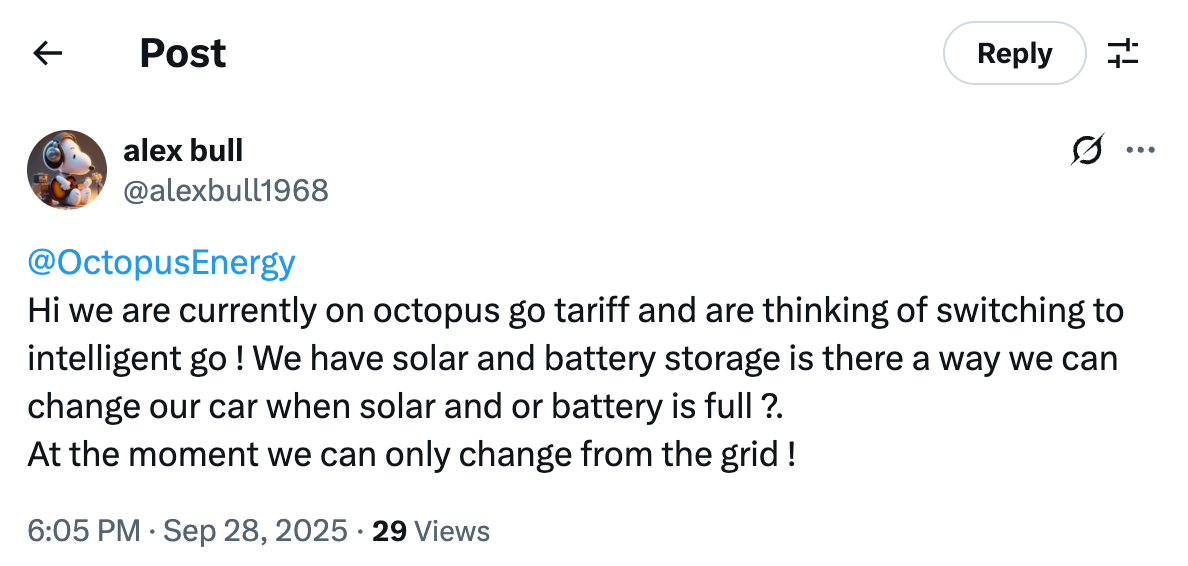
The issue here is that if you want to charge an electric car using any energy supplier's smart tariff low rate period often the wiring means the car will first draw energy from the home battery rather than the grid as the battery is simply doing what it's designed to - meet your home demand.
Yesterday (Sunday 12th Oct 2025) this came up on the panel session at Everything Electric too. I get asked about once a fortnight to look at this sort of issue but asking the audience for a hands up I counted around 20; higher than I was expecting.
The default behaviour of a solar battery system is:
- First the solar supplies energy to your home,
- then any excess goes into the battery to use later,
- and once the battery is full, then anything else simply exports to the grid
And the default is for the battery to provide enough energy back to your home when you’ve got insufficient solar to meet the demand.
So far so good; that’s all straightforward and logical.
I’ve emphasised ”enough” above and this is important - you generally don’t want the battery to simply discharge at full power and so both meet the demand and export to the grid. If you think of a battery powered torch, enough electricity is drawn from the battery simply because the bulb is the only thing that needs electricity from the battery. But our home battery supplies not only our home but also as much of the rest of the grid as it can. To stop that, it needs to know/measure how much your home needs, and to do that in real time all the time.
The most common method is with a CT (Current Transformer) Clamp that’s clipped onto the main supply right next to the smart meter. These are small black block devices with an arrow on the side (this MUST point in the direction of electricity supply) and a thin pair of wires back to the solar/battery system. The solar-battery system continuously adjusts the battery discharge to keep this reading as close to zero as possible.
Commonly electric car chargers, solar-battery systems and even air source heat pumps are wired via a pair of Henley Blocks (usually blue and brown blocks screwed to the electricity board) right after the smart meter and split off before the main consumer unit instead of opening the consumer unit and getting appropriately sized MCBs etc.
Sometimes the car charger and the solar-battery system might be wired via the same pair of Henley Blocks. But for the next bit to work you need a separate pair of blocks.
Where I’ve described the solar-battery system as measuring the whole home and managing the battery discharge to result in zero grid import/export then it’s clear that this is going to also include the electric car charging too. The battery will start to discharge to the car.
If you’re on Go or IO-Go then generally you probably don’t want to do this as you want the car to charge from the cheap grid costs leaving the electricity stored in the battery to supply your home during the day when rates are at the regular rate.
And the easiest way to achieve that is purely down to repositioning the solar-battery CT clamp.
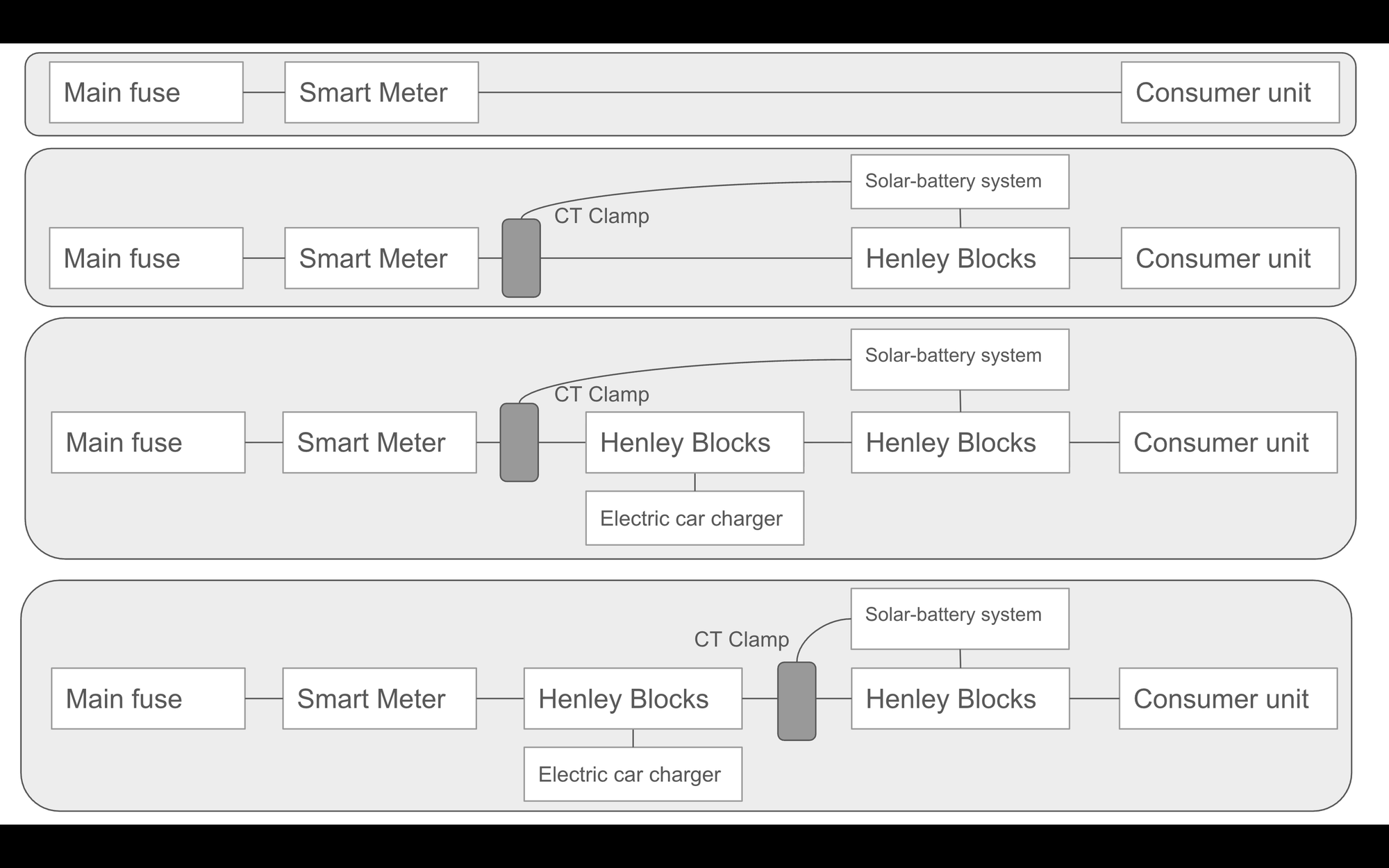
If you compare the 3rd and 4th diagrams above you can see the difference moving the CT Clamp makes and why this only works if there's two pairs of Henley Blocks.
Some manufacturers now have options in their apps to do this instead where you have a CT Clamp for the car charger as well as the whole home and their systems can stop the battery from meeting the car charging demand when the charging is sensed. This gives in-app logic so just by settings in the manufacturers app you can decide:
- Charge the car, or not, from the battery
- Charge the car only from grid
- Prioritise solar generation to the car first
- Etc
At Everything Electric audience members referred to manually applying battery schedule control (but less successful for IO-Go extra slots), Home Assistant (popular as it's so flexible), or the GivEnergy app (mainly if you have both battery & charger from them), or the Net Zero Energy app (mainly for Tesla Powerwalls). No doubt there are many more software based solutions available too.
But I like the CT Clamp placement solution as it's a simple fix so long as you've got the two pairs of Henley Blocks or a friendly electrician able to make the change for you.