Solar Days

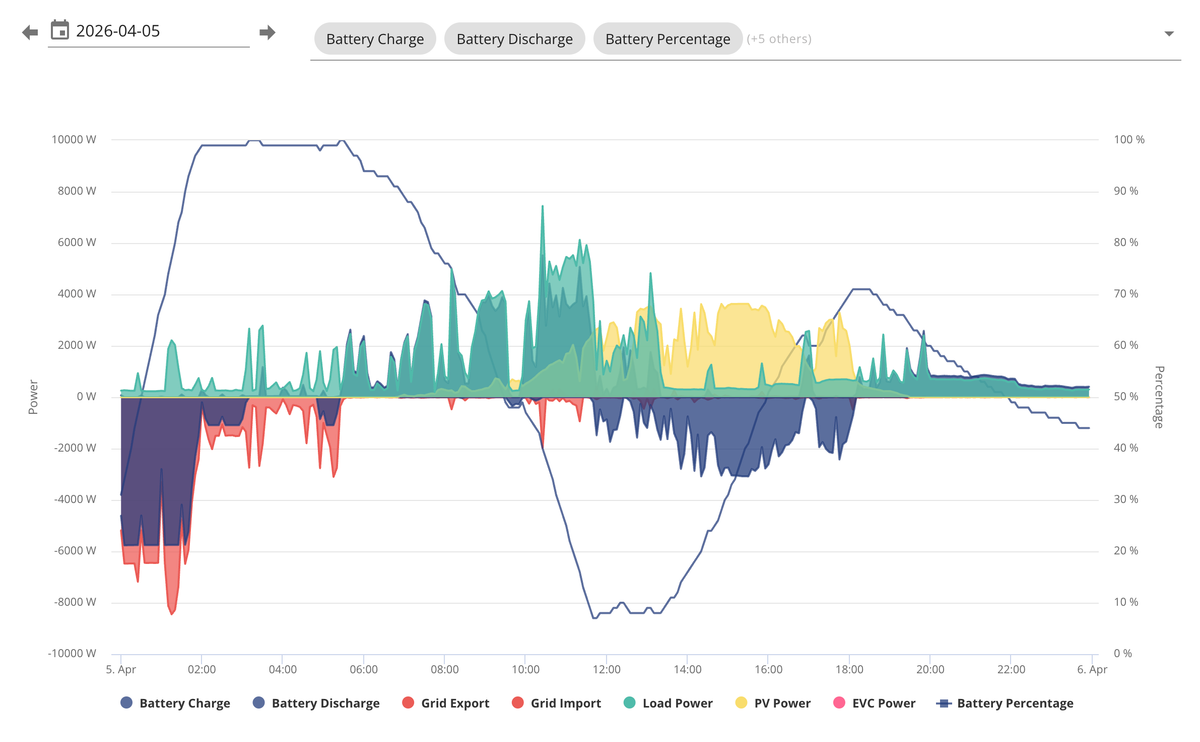
At last, we're getting some sunny days and a decent amount of solar but I've always wondered why we only get 10% production in the depths of winter compared to the summer when daylight hours are a bit less than half. In January the Earth is actually a bit closer to the sun too.
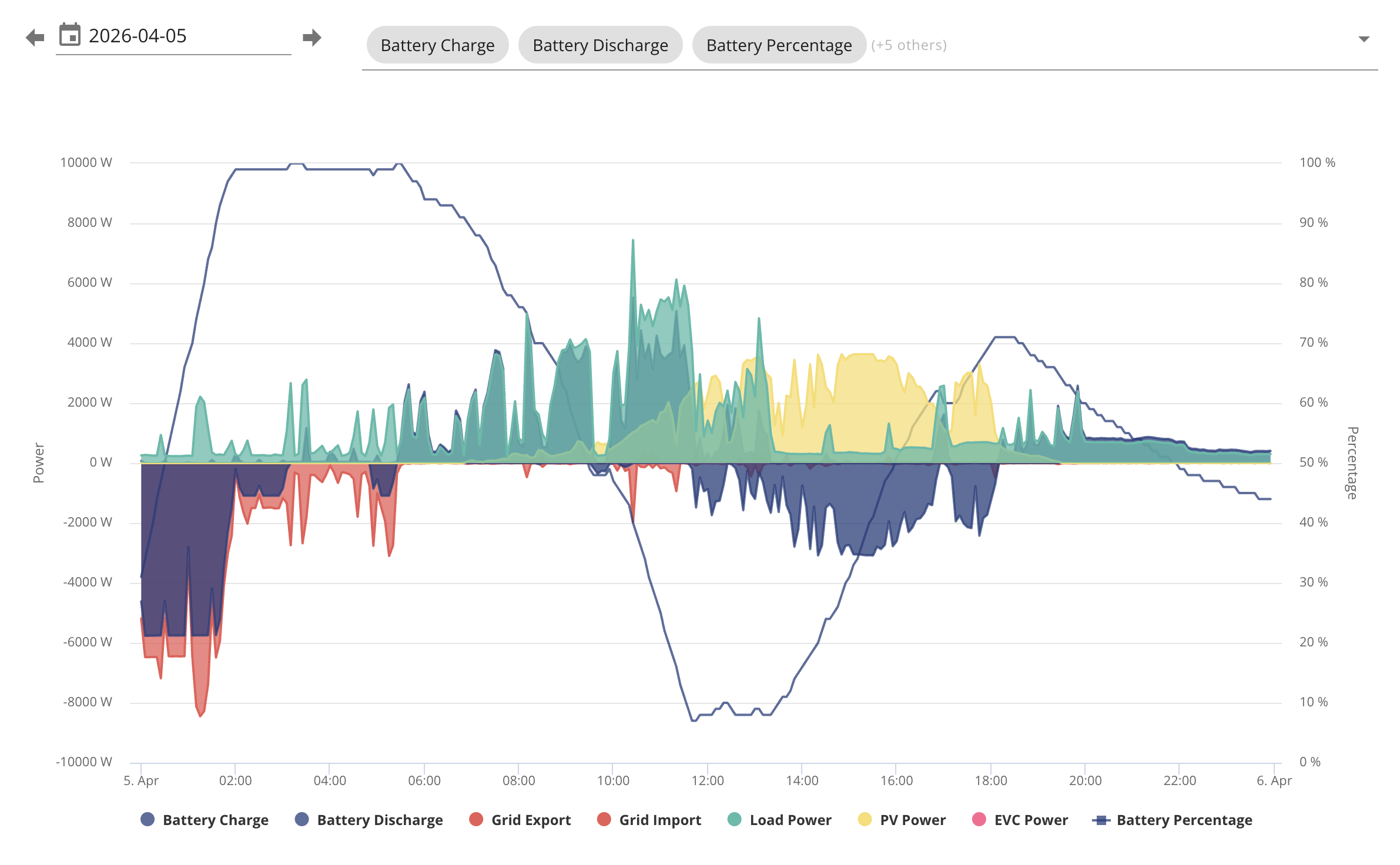
On Easter day (5th April 2026) we generated 19.5kWh but our generation varies from 1kWh to 30kWh winter to summer. As a rule of thumb a domestic system generates about 10% in the middle of winter of what it produces in the middle of summer.
So I went in search of the reasons for such a big difference.
1. Photoperiod (Daylight Hours)
Let's start with the difference between daylight hours.
- London Solstice Comparison:
- June 21: ~16 hours 38 minutes of daylight.
- December 21: ~7 hours 49 minutes of daylight.
That's a bit less than half so that on it's own doesn't explain it.
2. The Cosine Effect (Angle of Incidence)
As well as shorter days, the sun stays so low in the winter.
The maximum energy generation occurs when sunlight hits the panels at a 0° angle of incidence—perfectly perpendicular. As the sun is much lower in the winter, this angle increases, and we encounter the Cosine Law. Mathematically, the effective irradiance is proportional to the cosine of the angle between the sun’s rays and the panel's 'normal' (an imaginary line sticking straight out of the panel). Essentially, as that angle grows, the 'projected area' of the panel relative to the sun shrinks, diluting the energy density.
The formula for the power (P) generated is:
P(generated) = P(theoretical peak) x cos(θ)
where θ is the angle of incidence, described above. At noon in mid-summer, when the sun is high and θ is small, cos(θ) is near 1 (100% efficiency). In a UK December, with the sun hovering near the horizon, that angle becomes so wide that the cosine value (and therefore power generated) falls.
On a UK summer's day, the sun reaches an altitude of around 60°. In winter, it struggles to hit 15°. In other words the sun’s rays hit at such a glancing angle in winter that the "effective area" of the panel is reduced. If your roof is at a 35° pitch, the angle of incidence is roughly 40° so from the equation we get cos(40°) = 0.76 meaning a reduction of about a quarter.
P(generated) = P(theoretical max) x 0.76.
Se we've got as far as about half the daylight and two thirds of the generation - we're getting there.
3. Diffuse Horizontal and Direct Normal Irradiance (it's the atmosphere, and clouds)
Now we move on to the impact of the atmosphere and clouds - being lower in the winter that sunlight is travelling through more atmosphere to reach our panels and the winter is obviously more cloudy so these factors both affect the generation too.
Light from the sun hits the top of the atmosphere with an average intensity of 1,361W/m2 (the Solar Constant). The Sun is a massive nuclear fusion reactor and its total power output, or Luminosity, is approximately 3.828E+26 Watts at the surface of the sun. This energy radiates outward in every direction, so imagine a giant, ever-expanding sphere of energy but obviously reducing (the inverse square law) the further out you go. If we run the numbers for the distance the earth is from the sun we end up with an average of 1,361W/m2 but this varies as the Earth's orbit is elliptical so the figure in January is 1,412W/m2 and in July 1,321W/m2 (which is a bit counterintuitive for my investigation into why winter generation is so much lower). That actually means a 7% increase in the winter.
As sunlight passes through the atmosphere we end up with a mix of direct sunlight and diffused sunlight.
- Direct Normal Irradiance (DNI) is the solar radiation that comes in a straight line from the sun and on a clear UK day in June DNI can account for over 90% of the total generation.
- Diffuse Horizontal Irradiance (DHI) is sunlight that has been bounced off clouds, dust, and pollution. It arrives at the panels from all directions at once. In a typical UK December, DNI often drops to zero (because the sun is behind thick clouds) so the generation is running 100% on DHI.
And that diffusion (DHI) is mainly due to two types of scattering:
- Rayleigh Scattering (The Blue Filter): Small gas molecules in the air scatter shorter (blue) wavelengths. In winter, because the sun is at a low angle, the light travels through 2–3 times more atmosphere than in summer. This is why winter light looks "redder" or "weaker" - the high-energy blue photons have been scattered away before they hit the panels.
- Mie Scattering (The Cloud Filter): This is caused by larger particles like water droplets in clouds. Unlike Rayleigh scattering, Mie scattering is non-directional. It turns the sun's "beam" into a giant, glowing "light bulb" in the sky.
Without these they sky would actually be black just as it is if you were on the moon. Also shaded solar panels (shaded by a chimney or a tree or another property) would generate 0 W/m2 from the DNI.
Whilst we gain 7% by being closer to the sun, the result of there being virtually no direct sunlight in winter (and it being high diffused instead) and the sunlight passing through three times as much atmopshere reduces the generation by as much as 80% so overall about 75% reduction.
Panel Technology
We also need to consider how the panels produce electricity and the best way is to use a water flow analogy. Water pressure is like volts (DC from a panel), the flow of water is like amps and we can consider the inverter as a kind of valve which only starts producing (flowing) once there's enough pressure (volts).
A panel has something called the Open Circuit Voltage (Voc) which is the maximum voltage when there's no load attached and a Maximum Power Voltage (Vmp) when there is load applied. As soon as a load is applied the voltage will drop (like water pressure reduces as you open a tap). Voc for an individual panel can be 35V to 50V whilst the Vmp is only 30V to 40V.
When running, the inverter needs to reach a start-up voltage of between 120V to 200V (from the string of panels) so for all the reasons discussed earlier this means in December it can be quite late in the day before this start-up voltage is reached and generation can start.
But also the available current (amps) matters too. If there's not enough sunlight (atmosphere diffusion etc) then the Voc could be high but the amps (flow) too low (a bit like opening a tap fully but there's barely any water) so if power is drawn (P=IV) that will cause the Vmp to drop (or sag) and the inverter to cease supply once it falls below the minimum operating voltage.
This is one reason why longer strings of solar panels can be more beneficial in a UK winter as the voltage is the sum of all panels in the string (a bit like four AA 1.5v batteries supply 6v). But a string of solar panels are susceptible to shading - if one of say 6 panels is in shade the Vmp might be good but the flow (current) is reduced to that of the shaded panel so the power (P=IV) is significantly reduced by that one shaded panel.
Enter micro inverters.
To overcome shading and start-up voltage issues, micro inverters are becoming popular. Micro inverters can cope with a lower start-up voltage (20v to 30v) and being separate inverters the reduced current of a shaded panel doesn't affect the rest of the panels.
So there we have it
My winter solar is reduced due to a set of factors:
- Photoperiod (daylight hours) means I can generate around half the time.
- Cosine effect (angle of incidence) means I get about a 25% reduction.
- Direct and Diffuse Irradiance (sunlight versus grey days) differences causes 75% reduction.
Metric. Clear Summer Day Overcast Winter Day
Total Irradiance 1,000W/m2 50 - 100W/m2
Sun's principal Role Direct (DNI) Diffuse Glow (DHI)
DNI (Direct) 850W/m2 0W/m2
DHI (Diffuse). 150W/m2. 50 - 100W/m2
Atmospheric path Short & Thin Long & Dense
Typical Output 400+ Watts per panel. 40 Watts per panel
And so there's my winter 10% output:
50% x 25% x 75% = 9.4%
There's actually an overall term for this: GHI or GTI.
Global Horizontal Irradiance (GHI) is measured by a pyranometer on a flat horizontal surface and is essentially the measurement of Watts of solar energy in a square meter and can be found here, here or here.
And Global Tilted Irradiance (GTI) attempts to account for the roof angle, but that does mean:
In Summer: GTI is often lower than GHI because the sun is so high that a tilted panel actually misses some of the "overhead" intensity.
In Winter: GTI is usually higher than GHI. Because the sun is so low a tilted panel "faces" the sun better than a flat piece of ground does.
So, while it feels like the sun is just 'taking a break' in the winter, the reality is a mathematical triple-whammy. We lose half our daylight hours, our roofs are tilted at the wrong angle for the low sun, and the atmosphere itself acts like a thick grey filter that blocks 90% of the sun's intensity. When you combine shorter days with weaker light, generating 10% of your summer total is actually a testament to how hard those silicon cells are working!
If you want to verify the '10% rule' yourself, go to PVGIS, type in your coordinates and look at the GHI values for June and December.