What is a VPP and am I in one?

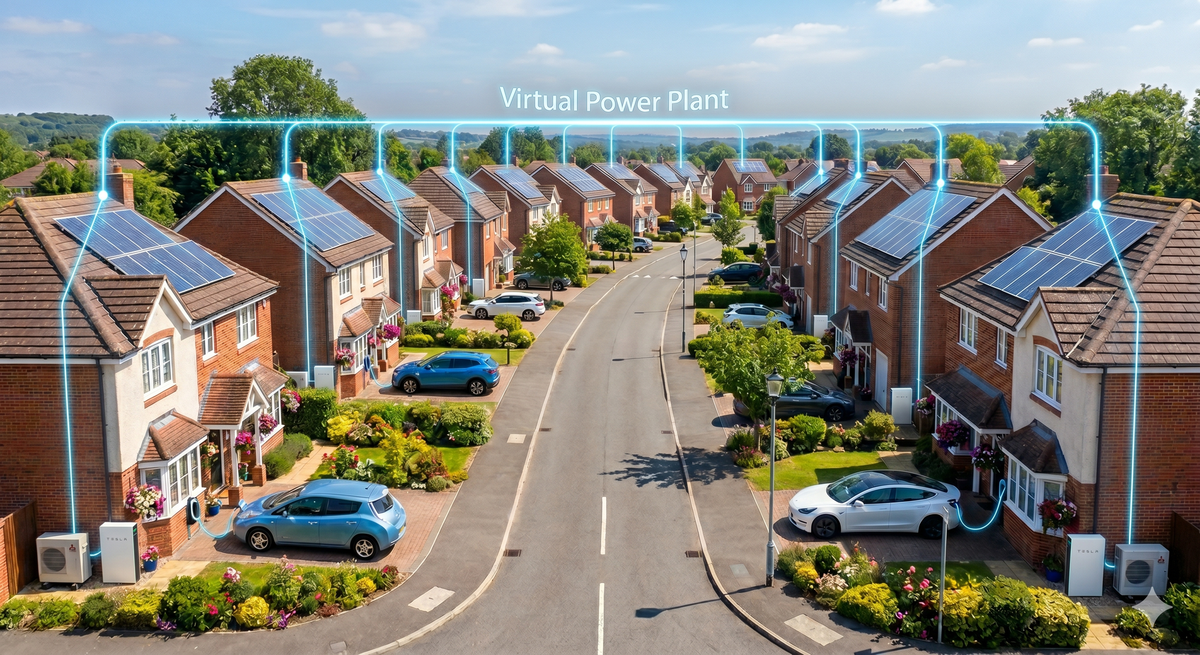
Electricity is produced by generators, or Power Plants; coal, gas, solar, wind, nuclear etc. A Virtual Power Plant (VPP) doesn't produce any electricity. Instead it's a collection of electrical assets that can react to requests for more or less generation (or demand) on the grid and so in a virtual sense appear to be a generator. The simplest is telling a battery to charge or discharge and in fact that means a VPP is not just a way to add ('generate') but also to reduce demand.
The grid is constantly being balanced ensuring there's always enough generation to meet demand. Easy in the days of coal generation as you just turn the dial up and down a bit (Ok that's an over simplification but bear with me). The distributed and intermittent nature of renewable generation makes balancing more dynamic. And charging cars and exporting home solar has a much greater impact on your grid connection than before (a car importing at 7kW, a home solar system exporting at 5kW). If we all charged our electric cars at 4.00pm there would be a problem.
Ever since we launched Agile Octopus and Octopus Go in 2018 price has been the influence of when to charge an electric car - why charge it at 4.00pm if it's 75% cheaper at 00.30. The Intelligent Octopus tariffs took this a step further by reacting to grid signals (Flexibility Markets) to dynamically inform cars to start/stop charging. And it's this element of control that's core to a Virtual Power Plant.
In fact, in grid, terms it's called a Virtual Lead Party (VLP) and was initially aimed at large scale commercial parties that could flex such as industrial cooling systems.
The grid is able to call on VLPs to either adjust generation (export from home batteries say) or adjust consumption (charge more cars) as well as the legacy instructions to actual Power Plants. VLPs were baked into the system in 2019 under BSC P344.
The term Virtual Power Plant seems easier to conceptualise than Virtual Lead Party so we tend to see 'being a part of a VPP' as the marketing term but isn't a standardised term. But a VPP doesn't truly map to a VLP as an organisation may register more than one VLP but present the collective as their total VPP. Deeper down VLPs are made up of Balancing Mechanism Units (BMUs) that address Contstraint Management Zones (CMZs) which I'd liken to the building blocks across the grid and are regional (usually by GSP).
Normally all billing/crediting is based on your MPAN - and if you've got solar you're likely to have both an Import MPAN and an Export MPAN. This is sometimes referred to as the Boundary Meter too although that's fairly uncommon in domestic properties to refer to it as that but we're likely to hear more about it as sub-metering (or Asset Metering to give it the correct name) is now happening. This is where flexibility billing/crediting can be applied based on the measurements of a device such as charging a car or a solar system.
In the world of electricity settlement P375 gave us the ability to use Asset Metering for flexibility balancing so we now have Asset Metering Virtual Lead Party (AM-VLP) - or we can interpret that as the ability for sub-metering for VPPs. There's also P483 but this dwells on sub-metering where a domestic property isn't half hourly settled at the Boundary (i.e. MPAN) Meter because Asset Metering has to be half hourly and deducted from the Smart Meter readings. But now we're well into the rollout of Market Half Hourly Settlement (MHHS) this is going to quickly become irrelevant although it might still remain as a safety net for failed smart meters.
The metering requirements specify that it need to meet Code of Practice (COP) 11. Within COP11 the measurement accuracy is referred to as IEC Class 2 (2% accuracy). Smart Meters are referred to as MID/MIR (Measuring Instruments Directive is the original EU term; Measuring Instruments Regulations 2016 is the UK term) compliant which has the same IEC Class 2 accuracy. There's a bit of an unnecessary debate if sub-metering should be MID/MIR or not but the bit that matters is the verified accuracy of measurement (i.e IEC Class 2).
Coming back to my point on tariffs (Agile and Go) although these incentivise time shifting it's clear now that a tariff without control isn't referred to as being part of a VPP. A VPP service means settlement related flexibility instructions are issued via a VLP so a time-of-use tariff without that element of control and flexibility isn't in a VPP. Hence if you're on Agile, Go, etc you aren't 'in a VPP' whilst if you're using the Intelligent Octopus tariffs then you are. That also means any third party app or service integrated to our APIs isn't technically forming a VPP either. It's also why the Intelligent Octopus tariffs aren't fully visible over the API as it's important we're measuring and controlling a known amount of flexibility.
We'll also start to see more about the difference between Boundary Meter (your MPAN) and device (Asset) Metering. When Flexibility happens at both we obviously end up with a clash so hence it's not possible to have flexibility reported via both the MPAN and the Asset Metering at the same time.
Everything I've written here is the current state at June 2026 and as will be obvious there's a lot more to come as this space evolves.